Wednesday, March 9, 2016

Got Myself Together: Danny Barnes Ten Years Later.

I pre-ordered Danny Barnes' new album as soon as it was announced. Got my CD in the mail, signed by the man himself. As expected, this is a great album by the fellow who is in my judgement the most exciting musician alive today. All the tracks are great. 

As it happened, I was flying to Seattle with my wife to pick up a truck and drive back home to New England, and took the opportunity to attend a house concert with Mr. Barnes in Portland Oregon. I had seen him twice before with JAB, but this was the first chance to see two full sets of his own songs. It was wonderful. 

So I bought another copy of the CD at the show, to listen to in the truck. We have been listening to it for over a month, making our way across the states. Within the first week, my wife was singing along to "The Cat To The Rat"; by the second week we both were singing "Lighthouse" together in the truck, singing harmony with Danny Barnes. 

That's the first time we ever sang together. I'll tell you something: if you never sang with your wife or husband, it's really worth a try. Makes you closer. People who sing in church already know this, it was new to me. 

We are still some thousands of miles from New England (taking a very indirect route) and if the truck holds up as well as this album, we should arrive in good shape by spring. 

So I am writing this not so much as a review, but as a thank you card.  I want Danny Barnes to know that his music has added something sweet to our trip and to our lives. 

Saturday, October 10, 2015

Mark Rubin's Southern Discomfort

Anybody that follows me on this blog (and I think one person does) knows that I am now for some years a Danny Barnes fanatic. So, it may come as no surprise to you that I am also a huge fan of the bass player from the Bad Livers, Mark Rubin. 

Mark is a virtuoso musician who can tear up some bass. He also plays pretty much every instrument, and has recently released an album, Southern Discomfort, where the variety of acoustic instruments are so well played and so well recorded it's beautiful to hear. 

Mark sent me a download of his record with the understanding that I would write him a review. I would have done so in a timely manner but there was a hitch. The album cover art is a really punk rock picture with a confederate flag and a bunch of Jewish symbols and KKK hoods and a noose.  It's disturbing; but the song about the lynching of Leo Frank (true story of an innocent Jewish man taken and killed by a mob in 1915) is what made me stop and think. 

The thing that got to me was that although we all have a lot of reasons to want to pretend that it's not so, not so much has changed, since then. It was not even that long ago. How much has the moral character of our fellows been uplifted in so short a time, or has it at all?

What people are capable of as individuals or as representatives of groups is daily on display, and from what I've seen I would be pressed to say what they are not capable of. In the context of this record, it's a sobering thought. Point being, if this crowd turns ugly, it's a mob. 

So that truth, a heavy one, is to me kind of the point of the album. The ease of research in these days will quickly reward an inquiry into the past and recent history of hate crime. For a general discussion to begin on the culture of racism and violence, in this country and in these times, the time has come. 

We have to thank Mark Rubin, an artist very busy perfecting his art for taking the trouble for bringing up this subject which I, like most, from fear have long sought to avoid. 


Thursday, July 3, 2014

test apes by the test apes


Here is another great record from Danny Barnes, this time with Max Brody, the drummer from Ministry. I am a huge fan, and this is making my day, to be sure. Even more, I feel like the last three records were kind of setting up for this one, stretching out the sonic limits of my expectations. I now have four new recordings from Danny Barnes and they just keep getting better and cooler. Ok, and weirder; but this is the reason I keep listening to this stuff. A lot of people talk about art, but when you look at what they're doing, all you see is technique. Not that it is a bad thing to be, a technician. But what art is supposed to do, the art that I like anyway, is to challenge and broaden the mind of the audience; to create something new. So where I might have been comfortable just hearing more of any of the things he does so well (ambiant, folktronics, acoustic banjo etc) Danny Barnes just keeps mixing it up and tying it back together with what Zappa used to call "conceptual continuity". These are more than just banjo records: they are re-framing the question of what can be done with music itself.


Friday, June 27, 2014

Junior Sampled, a great new album from Danny Barnes!


I finally got my pay-pal account working (seems they want you to have money in the bank) and bought both "Ambient Works Vol 1" and "Junior Sampled" after listening to both of them for free on Bandcamp whenever i had wifi signal on my phone. Initially, I thought this was another Ambient Work because of the black and white cover art and the title, and because after the last one I'm ready for as many more of those as I can get. However, it was instead another great album of songs like Shri108. Great social commentary lyrics, great beats, and plenty of bass and banjo.

Tuesday, May 13, 2014

Scott Thunes

This weekend I got to meet the great Scott Thunes. I had wanted to see this cat for such a long time. In 1988 I took a trip to California and found Zappa's album "Guitar" on cassette in a little gas station convenience store and played it on the car deck all the way up route 1 to Big Sur.

I was already a big Zappa fan, but this record was clearly better than all his others and it didn't take me long to figure out the reason was the new bass player, Scott Thunes. That tape was the mainstay of my playlist for years, I made duplicates so I wouldn't wear it out. I still have it.

It has been said that Zappa band members have often done their best work in Zappa's band and then done nothing noteworthy after. Well, here is an exception to that rule: Scott Thunes is doing his best work now. I caught his set Saturday night with the Mother Hips at a little music festival at Big Sur called the Hipnic. This is a great jam band setting to see Scott just shine.

His awesome command of the instrument and great taste brings funk, punk, jazz and rock to a point of just blowing my mind. I have not seen bass playing as good as that since I saw Mike Watt playing with Firehose in 1991. Part of what makes it so good is that the band is obviously in the process of growing musically into new and farther out spaces. So, that makes it sound really fresh. They are playing on the edge.

I am going to catch the Mother Hips show any time I can; they are a solid act, and a great way to see one of the world's best bass players at his best.

Sunday, April 13, 2014

Here's the link to Ambient Works Vol.1

https://dannybarnes.bandcamp.com/album/ambient-works-vol-1

New Danny Barnes record: Ambient Works Vol. 1

Things just keep getting better for me as a Danny Barnes fan. This new release continues on in the direction of Shri 108, but with an ambient bent. It has plenty of awesome banjo. 

Danny Barnes is the top philosopher in banjo music today. If you read his written pieces, he is just spot on about everything. He has in this ambient work created a sonic expression of his positive understanding of the world. 

This is a lot to ask of a musical piece, but he has done it here. Now granted, I have been doing my homework. Following up on his references, I have been reading Buddhist and other spiritual and philosophical material, Maher Baba, Thich Nhat Hanh, the Dalai Lama. This sort of thinking flows along well with ambient banjo music. 

I hope the implication in calling this work Vol.1 is realized in many more volumes to come. This recording creates peaceful space for my mind to wander around in. Just what I needed. 


Saturday, October 26, 2013

Shri108

I just got Danny Barnes' new album shri108 and it is his best yet, even further out than rocket. I had said that he is the Mozart of our time, but perhaps it is better to say Danny Barnes is the Dizzy Gillespie of our time. He's the most positive guy right in the middle of the hippest music going on today (and that's saying a lot), and a huge influence on a great many people in an underground kind of way. He is the best goodwill ambassador for the Americana style of music that takes old time music and acoustic instruments and brings it into a relevant context for today. There is so much good content on this record, cool rhythms, banjo tracks and mixing. Great, great record!


Wednesday, October 16, 2013

Friday, September 28, 2012

28 September 2012

I haven't had an update in a very long time, the computer has been broken since last winter. However, i told a couple of people about this blog, and felt i should post something.
The banjo diagrams should be posting up soon, i may be able to photo them. These and a few others i can post like this.
The recent release by marc ribot's ceramic dog, of an old protest song "bread and roses", is as one would expect, just great. He has an ability to sound so hip while playing so out there, it reminds me of jimi hendrix.
In banjo news, i got danny barnes's split livers cassette, and it was also really great. The cassette is still pretty viable, at $10.00 for 90 minutes of music. I will be on the lookout for more releases on tape.
Meanwhile, tapermark has released another danny barnes concert on the archive.org website, and video of the show on youtube.
In other news, i was recently reminded how important it is, no matter how good your tone is, to be in the right key. This includes the right mode. A little simple analysis like this can usually settle the matter:
How many sharps or flats? Well, you can lay out all the chords, write down the notes, and just count them. While you don't have time to do this on stage, you certainly do at home.
Another method is by looking which chords are major or minor. A major chord is going to be a one chord, a four chord, or a five. So in the first chord, you've narrowed it down to one of three keys. Practically speaking, if it's a major tonality it will be major scale or mixolydian, if it's a minor tonality, it will be natural minor scale or else dorian.
So that narrows it down to two choises, presuming you can tell a major from a minor tonality. (Here's a hint, if it starts on a major chord, it's a major tonality.) The way you tell major from mixolydian most easily is if you're playing the flat seventh of the scale ( b flat in the key of c, for example ) then you're mixolydian.
In the minor tonality, you look at the 6th. If it's a flat 6th ( a flat in the key of c, for example ), then it's natural minor. Otherwise, it's dorian.
My point is, be sure you know this much about the song before you start playing it (particularly on stage, i mean). It's ok to depart from the modality, but you have to know what it is you're departing from, or you ain't ever going to get back.

Wednesday, December 21, 2011

Happy New Year!

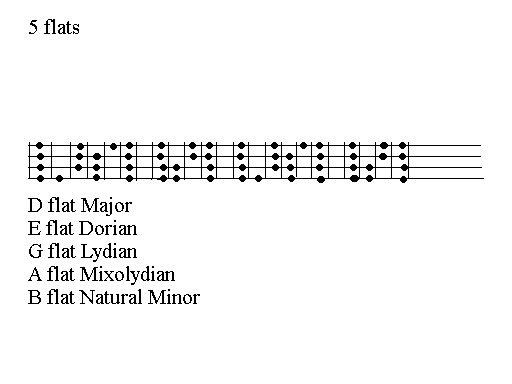
Here are the first of the banjo diagrams. The banjo is ordinarily tuned to an open g chord (gDGBD).


This tuning makes the related modes of G major fall very naturally on the open strings, and the modes of D are also pretty easy, as are those of C major and F major. Depending on what tonality the song is in, the short 5th string can be tuned to anything that sounds good.

Monday, November 28, 2011

Tom Waits, Marc Ribot, and Danny Barnes

Well, it has been a while since I posted anything, so here's an update:


I've been playing gigs again on bass since last spring, playing country alternative folk rock or some such combination, some very different music from what I had always played( which was blues professionally, punk and acid rock on the side). All the music I had ever played: garage rock, blues, whatever; we always had a drummer. Lately all my gigs are coffee houses and small bars; duos, trios and quartets with no drummer, but with guitar, fiddle and/or mandolin.


Since last fall  I have been listening to a lot of Tom Waits music. A long time ago I had mistakenly dismissed him as some kind of novelty act, not realizing that he was a variety act. He plays a very broad selection of music, and I became interested in how he creates a musical environment where instruments such as banjo, accordion, or clarinet or really any instrument could find a place in the mix.

The Mothers could do that, and Captain Beefheart could as well; there is a great deal to be said for the dynamic control that makes it possible. It opens up a subtler range of expression.  Researching Tom Waits led me to discover a great guitarist, Marc Ribot. The first time I heard him with John Zorn, I thought that I hadn't heard anything that good since Zappa and Garcia. Since then I have heard more from him that confirms my initial impression, which is that he could be the best living guitar player (that I know of). His work with his own projects, Los Cubanos and Ceramic Dog have some of the most expressive guitar ever recorded, and his recent solo album, Silent Movies is some of the most beautiful classical sounding guitar I have ever heard.


There is a musical fearlessness in Tom Waits and Mark Ribot that goes beyond the ordinary conventions of  music. They show a spirit that in years past had been exemplified by Theolonius Monk, Miles Davis and John Coltrane.  They play like they have nothing to lose. At the same time they can play the sweetest most openly emotional kind of songs and keep them real.

Along with jazz, there is a lot of old time country in Tom Waits music, and in researching this, I found a lot of great old time country banjo players. Players like Ralph Stanley and Clarence Ashley often really didn't have anything to lose, even Earl Scruggs and many other successful players back then were sailing pretty close to the wind as it is accounted today; lesser known or unknown banjo players from that time were preserved only in field recordings on reel to reel tape (which can accessed at the Smithsonian website).

 The banjo has a great many virtues, and among them is that it can be played in a greatly diverse number of ways. I had imagined that I had a broad sort of general concept of what that might mean: you could conceivably play anything on banjo, jazz, rock, classical, funk. I had been playing banjo for a little over a year by this fall; in fact I hadn't played much guitar since I got the banjo up and running.   The old time sound  lent a mysterious air to the mix, a sound that suggested a lot of possibilities.

So while looking for more banjo music, I found out about Danny Barnes. This is a guy who ties a lot of the most diverse musical elements together with the banjo. He is able to not only bridge the gap between Zappa and Garcia (having a great measure of what I like in both their playing), but to take the fearless improvisation of the way out jazz, the freaks and the punks and tie it in with the deep traditional mountain music.

In addition to having incredible chops on the banjo, and being a terrific singer and songwriter ( I keep finding new recordings of his, each one better than the last; which has me thinking I don't yet know the half of it ), Danny Barnes has a very tasteful and new approach to recording and integrating the banjo with analog and digital processing which is at the same time old school and cutting edge. He has a great take on the use of the old technology like cassette tape and his writing on the subjects of recording and sound (and all the other stuff on his blog ), is really profound. You can hear the freshness of his ideas by getting a cassette from him. "Poison", the demo version of his recent release "Rocket" ("Angel" is the acoustic version), is fully loaded with sound, very impressive to anyone who hasn't thought much about cassettes lately. The bass is so dense, I thought I was going to wreck my speakers, made MP3 and WAV files sound anemic by comparison. Reminds me of the mix tapes my brother used to make me years ago.


So it is with this inspiration that I am going to go ahead and post up (over the winter) all my diagrams for banjo and some new ones I am going to make up for mandolin and fiddle. Stay tuned.

Sunday, November 14, 2010

Modes for Bass

Here are the modes for bass; I thought I posted these things months ago, but I guess I forgot.

I wish I would have made up these diagrams and learned them twenty years ago when I was playing bass every night (and had as much time as I wanted to practice). Might still be playing in bands if I had.

So you beginner bass players (this means you, Nakaia) take notice: now's the time!